
Corporate results confirm worst fears about growth trajectory.

The Union Budget for 2026-27, presented by Finance Minister (FM) Nirmala Sitharaman on Sunday, which was a first, had an excellent domestic macro backdrop. According to the first advance estimates, gross domestic product (GDP) in constant prices is projected to grow 7.4 per cent in the current financial year, against 6.5 per cent in 2024-25.

India's GDP is poised to accelerate to 5.5 per cent in 2014-15 on the back of improved performance in industry and services but it may take some time for the country to reach its potential growth rate, says an Asian Development Bank (ADB) report.
"Growth is expected to moderate gradually in China... pick up in India, and remain broadly stable in the Asean-5 region."

Headline growth was quite weak heading into the Covid period but averaged 6.4 per cent and 6.7 per cent in the five years between FY16 and FY20 for GVA and GDP respectively, points out Abhishek Upadhyay.

Indian economy is witnessing stable growth momentum, says OECD.
The RBI projection of 6.9 per cent GVA growth for the current fiscal comes on the back of the Economic Survey last week forecasting economic growth of 6.5 per cent.
The panel noted that the macro-economic fundamentals of the economy are sound but challenges remain, several of which are structural in nature.

India economy clocked a five-year high growth rate of 7.6 per cent in 2015-16.

Retail inflation rose to three-month high of 4.81 per cent in June, mainly on account of hardening prices of food, according to the government data. Inflation based on the Consumer Price Index (CPI) stood at 4.31 per per (revised upward from 4.25 per cent) in May and 7 per cent in June 2022. The inflation, however, remains within the RBI's comfort level of below 6 per cent.

The Economic Survey was tabled in the Parliament on Friday.

As against an annual average growth of 10-11 per cent envisaged for the industry during the period, the actual annual average growth stood at 7.2 per cent during the plan period.

Among other things, the agenda is likely to focus on increasing private investment, employment generation and giving relief to the farm sector

India on track to be third largest consumer economy by 2025.
This kind of growth will turn India into a $8 trillion economy.
The government propagandists should refrain from premature celebrations and misplaced euphoria: Congress.
The Survey lists some of the challenges that might impede India's progress.
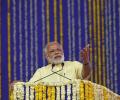
The prime minister was speaking at an industry meet organised at ONGC Petro Additions Ltd's complex in Gujarat's Dahej.
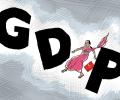
'Given that the economy is going through a slowdown, further downward revisions of the 2019-2020 growth estimates cannot be ruled out,' notes A K Bhattacharya.

On the revenue front, the finance ministry was expecting higher proceeds from non-tax revenue.
Credit rating agency Crisil observed in its report that some 'high frequency indicators go out of whack' as credit growth and service tax collections are not in tune with the CSO's growth projections.

The size of the GDP in the second quarter of 2018-19 is estimated at Rs 33.98 lakh crore, as against Rs 31.72 lakh crore a year ago

This was even as the country's economy grew by 7.3%.

Nearly 3.64 lakh educated and "semi-educated" youngsters had registered with employment exchanges across Gujarat till December 2021, according to state government data.

The previous high GDP growth of 8.1 per cent was recorded in April-June quarter of 2016-17.
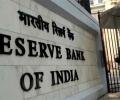
Headed by Urjit Patel, MPC for the fourth straight time kept the repo rate unchanged, at which it lends to the banks, at 6.25 per cent. The reverse repo, at which RBI borrows, will be 6 per cent.
It is pegged at 6.8-8% by various economists, as compared to 6.7%.

'While China has been hiking its defence spending, India has done precious little in implementing the Manmohan Singh government's decision of raising a 90,000-strong China-centric Mountain Strike Corps,' says Rajeev Sharma.

The new IIP numbers should spread cheer among those who were part of the Manmohan Singh-led United Progressive Alliance, earlier accused of having presided over a steady deterioration in industrial performance, particularly in the last two years of its tenure, says A K Bhattacharya.
 © 2026 Rediff.com - Advertise with us - Disclaimer - Privacy Policy - Sitemap - Feedback - About us - Terms of use - Grievances